
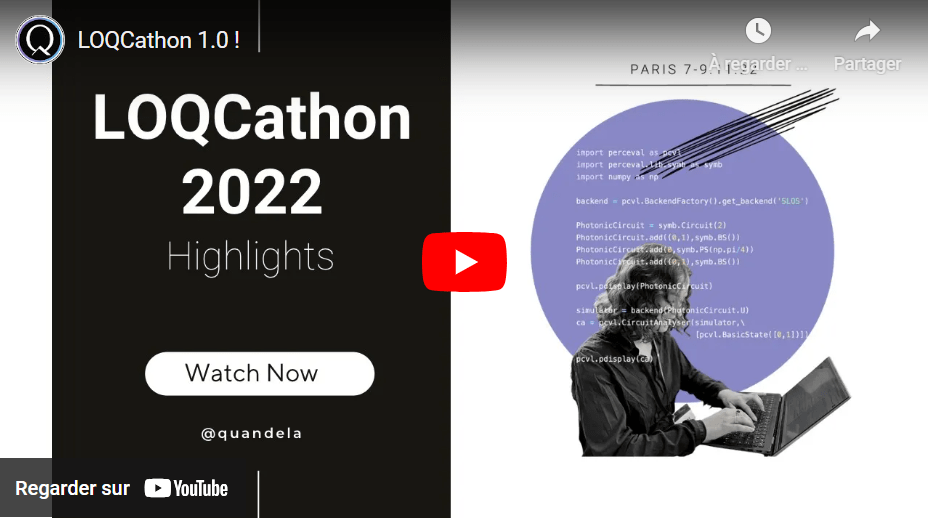
3 days, 12 teams, 60+ participants from more than 10 countries across Europe, 5 projects, 3 prize team winners. At the Crossroads of Physics and Software, LOQCathon was the first interdisciplinary Quantum Hackathon on Linear Optical Quantum Computation with the software platform Perceval, powered by Quandela with a partnership of QICS (Quantum Information Center Sorbonne)…


Explore More
October 7, 2026
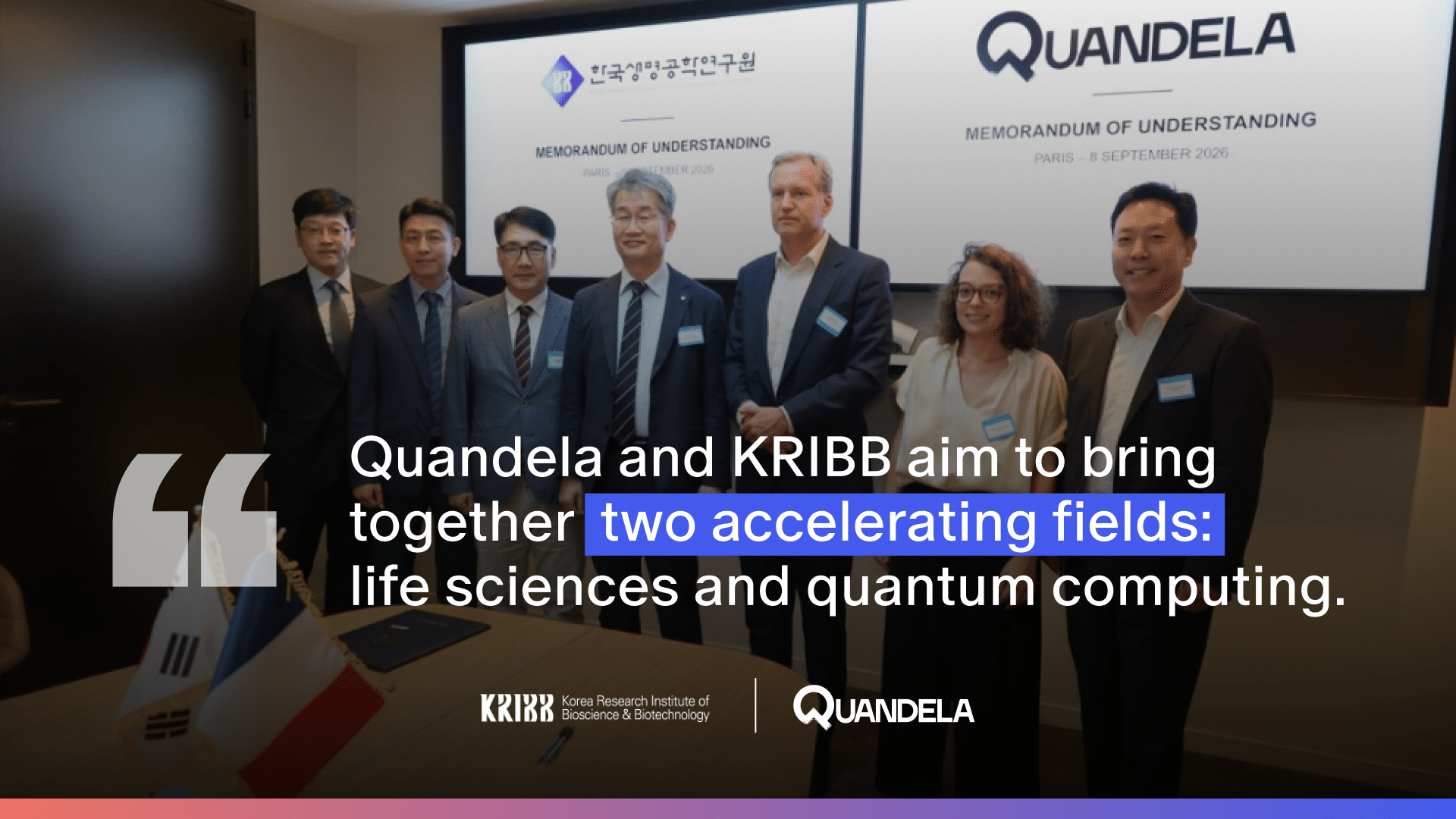
The partnership between Quandela and the Korea Research Institute of Bioscience and Biotechnology (KRIBB) aims to develop new use cases combining artificial intelligence, classical computing, and photonic quantum computing to tackle some of the most complex challenges in the life sciences. Massy, October 7, 2026 – Quandela, a European company, leader in photonic quantum computing,…
Read more
Quandela and KRIBB join forces to accelerate biotechnology research and drug discovery through photonic quantum computing
×
The partnership between Quandela and the Korea Research Institute of Bioscience and Biotechnology (KRIBB) aims to develop new use cases combining artificial intelligence, classical computing, and photonic quantum computing to tackle some of the most complex challenges in the life sciences.
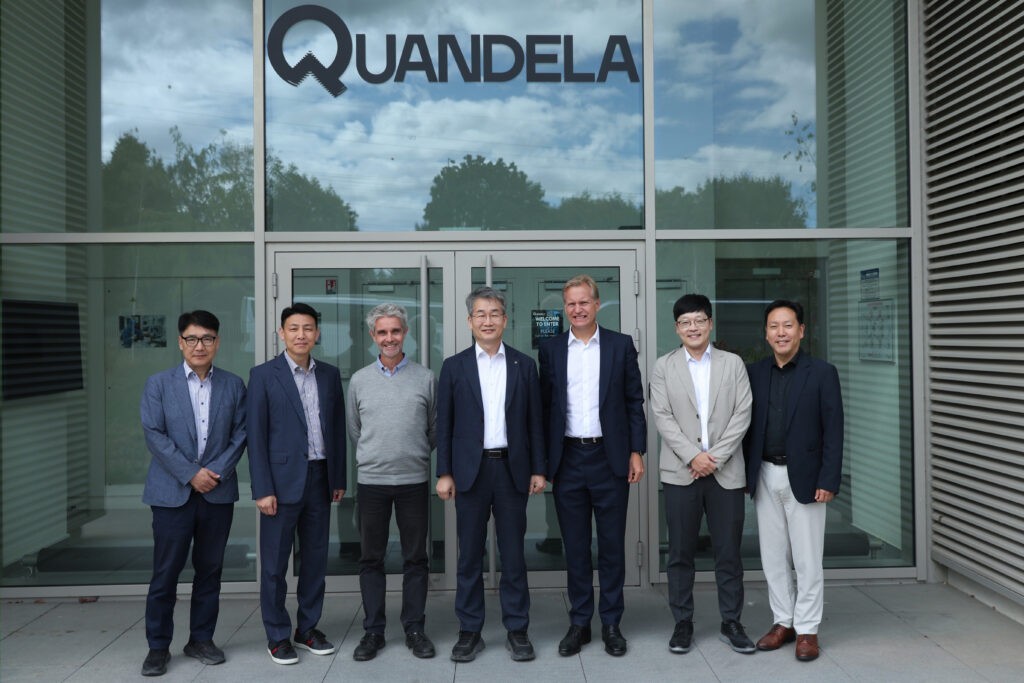
Massy, October 7, 2026 – Quandela, a European company, leader in photonic quantum computing, and the Korea Research Institute of Bioscience and Biotechnology (KRIBB), South Korea’s national reference institute for biosciences and biotechnology, signed a Memorandum of Understanding (MoU) in Paris on September 8, 2026, to strengthen their collaboration on applying quantum technologies to advanced biotechnology research and drug discovery.
Through this partnership, Quandela and KRIBB aim to bring together two accelerating fields: life sciences and quantum computing. Their objective is to develop and validate practical applications of photonic quantum computing capable of addressing complex biological challenges, while pioneering new research models that combine artificial intelligence, classical computing, and quantum technologies.
This partnership arrives at a pivotal moment to strengthen Franco-South Korean scientific and technological cooperation. Building on the Memorandum of Understanding signed in Paris on September 8 during South Korean President Lee Jae-myung’s state visit, both nations have committed to deepening collaboration in key strategic sectors, including artificial intelligence, semiconductors, and quantum technologies.
“Our goal is to give researchers new tools for navigating the complexity of biological systems. By combining KRIBB’s bioscience expertise with Quandela’s photonic quantum technology, we aim to accelerate the path from computational insight to experimental validation.” says Suk-Yoon Kwon, President at KRIBB.
Combining AI and quantum technologies to explore new frontiers in biomedical research
By combining KRIBB’s expertise in biotechnology and life sciences with Quandela’s capabilities in photonic quantum computing, both partners aim to develop new approaches for analyzing and solving biological problems characterized by vast search spaces and complex interactions.
Several application areas will be explored: Targeted Protein Degradation (TPD), particularly the design of PROTAC candidates; cellular therapy optimization; the identification of new therapeutic targets for rare diseases; and the analysis of gene regulatory networks involved in infectious diseases.
“Quantum computing becomes meaningful when it helps researchers solve real-world problems. With KRIBB, we are developing hybrid workflows that combine AI, classical computing and photonic quantum computing to create practical, reproducible applications for biotechnology and drug discovery.” says Sam Yoosuk Kim, General Manager of South Korea at Quandela.
At the core of this partnership lies a hybrid computing approach that seamlessly combines artificial intelligence, classical computing, and photonic quantum technologies. AI enables the analysis of large volumes of biological data and progressively narrows down the number of candidates to evaluate. Classical computing resources then handle processing and simulations suited to their architectures, while photonic quantum processors are deployed to explore particularly complex combinatorial optimization problems.
The project seeks to assess how this integrated model can refine the way researchers prioritize and select candidates prior to experimental validation, particularly in drug discovery, cell therapy design, and genetic target identification.
Transforming initial research into reproducible use cases
As part of this collaboration, KRIBB researchers have already shared initial findings generated on Quandela’s platform, with plans to build upon these results for an upcoming scientific publication. For its part, Quandela will analyze these outcomes as a breakthrough use case for photonic quantum computing in biotechnology, aiming to assess their reproducibility and potential to address broader drug discovery challenges.
Training a new generation of researchers at the intersection of biology, AI, and quantum technologies
Beyond joint research, the partnership also focuses on talent development. Both organizations plan to launch joint training programs, hackathons, seminars, scientific workshops, and technology exchange initiatives to support work at the intersection of biosciences, artificial intelligence, and quantum computing.
About Quandela
Quandela is a global leader in quantum computing, designing, building, and delivering cutting-edge quantum solutions for research and industry: providing the most energy-efficient quantum computers for computing centers, comprehensive quantum computing solutions accessible via the cloud, and algorithm access services for academic and industrial customers. Quandela follows a pragmatic and progressive roadmap, deploying industrial systems since 2023 while developing future generations of fault-tolerant quantum computers capable of scaling by integrating thousands of photonic components. Quandela is committed to making quantum computing accessible to all in order to tackle the most complex industrial and societal challenges. For more information: www.quandela.com
About KRIBB
The Korea Research Institute of Bioscience and Biotechnology (KRIBB) is one of South Korea’s leading national research institutes specializing in biotechnology and the life sciences. Founded in 1985, KRIBB works to advance scientific knowledge in areas including molecular biology, genomics, bioinformatics, synthetic biology, and aging research. As a government-funded institute, KRIBB plays a key role in fostering innovation, supporting national research and development strategies, and collaborating with academic and industry partners in South Korea and internationally. For more information: https://www.kribb.re.kr
Press Contacts
Quandela – Maarc Agency
- Iva Baytcheva – iva.baytcheva@maarc.fr – 06 28 59 07 03
- Oréna Cigar – orena.cigar@maarc.fr – 06 52 02 93 35
September 14, 2026
For IEEE Quantum Week 2026, held in Toronto from September 13 to 18, Quandela is showcasing an approach to progressively integrating quantum computing into existing AI and high-performance computing (HPC) infrastructures with NVIDIA NVQLink. In this approach, the GPU remains at the core of the AI workflow, with the quantum processor (QPU) acting as a…
Read more
Quandela publishes a vision for integrating QPUs into AI and HPC infrastructure with NVIDIA NVQLink
×
For IEEE Quantum Week 2026, held in Toronto from September 13 to 18, Quandela is showcasing an approach to progressively integrating quantum computing into existing AI and high-performance computing (HPC) infrastructures with NVIDIA NVQLink. In this approach, the GPU remains at the core of the AI workflow, with the quantum processor (QPU) acting as a specialized accelerator for specific workloads.
Paris, September 14, 2026 – Building on our June announcement of a low-latency integration between a Quandela photonic QPU and NVIDIA AI infrastructure, the companies are publishing a technical white paper today. This paper outlines a vision and architectural framework for gradually integrating quantum computing into current AI and HPC environments.
This approach is based on the complementarity of CPUs, GPUs and QPUs. The CPU orchestrates workflows, while the GPU remains at the center of AI processing, notably handling intensive computation and simulation. The QPU acts as a specialized accelerator for workloads for which quantum computing could bring significant value.
Thanks to the NVIDIA CUDA-Q platform (an open quantum-GPU supercomputing programming platform) and NVIDIA cuQuantum (an SDK optimized for simulating quantum computations on GPUs), algorithms can be developed, simulated and tested on GPU before being run on an actual photonic QPU. NVIDIA NVQLink enables a low-latency connection between the NVIDIA GPU environment and the Quantum System Controller, which then controls the QPU.
Organizations can thus progressively explore quantum applications by relying on their existing computing infrastructure, without having to replace their current environments.
A step toward more accessible quantum computing
By facilitating the integration of quantum computing into current AI and HPC environments, this platform empowers users to experiment, develop, and test quantum applications directly from their standard workflows.
The primary goal is to identify workloads where quantum computing can deliver significant value and progressively bring the most relevant applications to light.
The collaboration follows a three-step approach: Access, Integration & Discovery, and Scale.
- Access allows researchers and organizations to discover and experiment with quantum computing without having their own infrastructure.
- Integration & Discovery involves integrating the QPU into existing CPU and GPU environments to develop, simulate and test various algorithms, and to identify the workloads for which quantum computing could be particularly relevant.
- Scale aims to scale up applications that have demonstrated their potential toward larger, more powerful quantum systems.
This approach allows users to progress step by step toward quantum computing, building on their existing infrastructure and developing new capabilities as high-potential applications are identified.
An architecture presented at IEEE Quantum Week
The architecture developed by Quandela building on NVIDIA technologies will be presented at IEEE Quantum Week 2026 in Toronto on the morning of September 17, at the NVIDIA booth (#600).
At the event, Quandela’s teams will discuss the integration of photonic QPUs into AI and HPC infrastructures with visitors and present their joint publication on this new hybrid architecture combining GPU and QPU computing capabilities.
Jean Senellart, Chief Technology and Product Officer at Quandela states:
“The challenge is no longer just about accessing a QPU, but about integrating it directly into AI workflows. With NVIDIA, we are opening a path where the photonic QPU becomes a specialized accelerator for exploring and validating hybrid algorithms, particularly in QML, before scaling the most promising use cases.”
Sam Stanwyck, Director of Quantum Product at NVIDIA says:
“Quantum computing becomes more useful when it moves beyond standalone access and becomes part of the accelerated computing researchers already use. Our work with Quandela provides a step-by-step model for bringing photonic QPUs into NVIDIA quantum-GPU supercomputing, helping teams identify promising applications today and scale them as more powerful systems come online.”
About Quandela:
Quandela is a global leader in quantum computing, designing, building and delivering cutting-edge quantum solutions for research and industry. Its offering includes the most energy-efficient quantum computers for data centers, cloud-accessible full-stack quantum computing solutions, as well as algorithm access services for academic and industrial clients. Following a pragmatic, step-by-step roadmap, Quandela has been deploying industrial-grade systems since 2023 while developing future generations of fault-tolerant quantum computers, capable of scaling through the integration of thousands of photonic components. Quandela is committed to making quantum computing accessible to all in order to address the most complex industrial and societal challenges. To learn more: Quandela | Leading Photonic Quantum Computing Solutions
Media Relations
Maarc PR agency
- Iva Baytcheva, iva.baytcheva@maarc.fr +33(0)6.28.59.07.03
- Oréna Cigar – orena.cigar@maarc.fr +33 (0)6 52 02 93 35

September 11, 2026
Announced during the Vietnam–France Leaders Forum, in presence of Vietnamese General Secretary and President Tô Lâm and French President Emmanuel Macron, the agreement combines Quandela’s full-stack photonic quantum computing platform with Quanova’s local integration capabilities, backed by strategic investment from Nam A Bank, to develop talent, infrastructure and concrete quantum use cases in Vietnam. Paris,…
Read more
Quandela and Quanova sign strategic partnership to build quantum capabilities in Vietnam
×
Announced during the Vietnam–France Leaders Forum, in presence of Vietnamese General Secretary and President Tô Lâm and French President Emmanuel Macron, the agreement combines Quandela’s full-stack photonic quantum computing platform with Quanova’s local integration capabilities, backed by strategic investment from Nam A Bank, to develop talent, infrastructure and concrete quantum use cases in Vietnam.
Paris, 11 September 2026 – Quandela, a European leader in photonic quantum computing, and Quanova, a Vietnamese quantum technology and ecosystem development company, announce the signing of a strategic partnership agreement aimed at supporting the long-term development of quantum computing capabilities in Vietnam.
The agreement was formalized during the Vietnam–France Leaders Forum, held in the presence of French President Emmanuel Macron and General Secretary and President of Vietnam Tô Lâm as part of his official visit to France.
Under the agreement, Quanova will act as a strategic integrator for Quandela in the Vietnamese market. The two companies will work together to promote, develop and commercialize solutions based on Quandela’s photonic quantum computing technology.
Their collaboration will include the training of Quanova’s technical and commercial teams, the development of joint offerings, customer engagement and demonstrations, and the identification of relevant use cases with Vietnamese universities, research organizations and businesses.
“Vietnam is emerging as one of Southeast Asia’s most dynamic quantum ecosystems. Our ambition is to help turn this momentum into lasting capabilities: trained talent, access to photonic quantum computing and concrete projects for universities, research institutions and businesses,” said Niccolo Somaschi, co-founder and CEO of Quandela. “Quanova’s strong local roots and expertise as a strategic integrator make it the right partner to build this bridge with us.”
The agreement builds on several initiatives already undertaken by Quandela and its Vietnamese partners. With Quanova and other local stakeholders, Quandela recently supported a quantum hackathon organised by VNQuantum and the province of Gia Lai, focused on applications connected to Vietnam’s development priorities.
One of the first concrete initiatives supported by the partnership with Quanova is the quantum technology training programme at Quang Trung University, backed by Nam A Bank as a strategic investor. The programme aims to train students and researchers while expanding their access to quantum computing capabilities.
“Vietnam’s opportunity in quantum will be built through real capabilities: trained teams, access to world-class platforms and projects connected to local needs,” said Rossy Nguyen Hoang Hong Nhung, CEO of Quanova. “Working with Quandela will help Vietnamese organizations move from initial exploration to concrete applications, while strengthening the national ecosystem for the long term.”
The two companies also share the ambition of preparing for the future deployment of a photonic quantum computer in Vietnam. Their approach is based on ensuring that any future infrastructure is supported by the skills, software and local ecosystem required to use it effectively and create long-term value.
The agreement signed in Paris provides a framework for developing joint offerings and new opportunities with Vietnamese stakeholders. Quandela and Quanova expect to announce further concrete steps in the coming months.
About Quandela
Quandela is a leading quantum computing company that designs, builds, and delivers cutting-edge quantum solutions for industry: ready-to-use quantum computers for data centres, cloud-accessible quantum processors, and algorithm access services for industrial clients. Quandela is committed to making quantum computing accessible to all in order to address the most complex industrial and societal challenges.
Discover our vision at: Quandela | Leading Photonic Quantum Computing Solutions
About Quanova
Founded in 2025, Quanova is a Vietnamese quantum technology and innovation company focused on education, quantum-readiness consulting, ecosystem building and international collaboration. The company works to connect research, industry and talent development to support the emergence of quantum capabilities in Vietnam.
For more information: www.quanova.org
Media Relations
Maarc PR agency
- Iva Baytcheva, iva.baytcheva@maarc.fr +33(0)6.28.59.07.03
- Oréna Cigar – orena.cigar@maarc.fr +33 (0)6 52 02 93 35